

Challenge Yourself with the World's Most Realistic SPLK-1005 Test.
For the following data, what would be the correct attribute/value oair to use to successfully extract the correct timestamp from all the events?
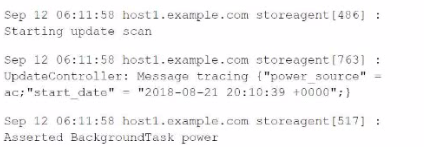
A. TIMK_FORMAT = %b %d %H:%M:%S %z
B. DATETIME CONFIG = %Y-%m-%d %H:%M:%S %2
C. TIME_FORMAT = %b %d %H:%M:%S
D. DATETIKE CONFIG = Sb %d %H:%M:%S
Explanation:
The correct attribute/value pair to successfully extract the timestamp from the
provided events is TIME_FORMAT = %b %d %H:%M:%S. This format corresponds to the
structure of the timestamps in the provided data:
Which of the following are default Splunk Cloud user roles?
A. must_delete, power, sc_admin
B. power, user, admin
C. apps, power, sc_admin
D. can delete, users, admin
Explanation: Default Splunk Cloud roles include power, user, and admin, each with unique permissions suitable for common operational and administrative functions.
Files from multiple systems are being stored on a centralized log server. The files are organized into directories based on the original server they came from. Which of the following is a recommended approach for correctly setting the host values based on their origin?
A. Use the host segment, setting.
B. Set host = * in the monitor stanza.
C. The host value cannot be dynamically set.
D. Manually create a separate monitor stanza for each host, with the nose = value set.
Explanation: The recommended approach for setting the host values based on their origin when files from multiple systems are stored on a centralized log server is to use the host_segment setting. This setting allows you to dynamically set the host value based on a specific segment of the file path, which can be particularly useful when organizing logs from different servers into directories.
What two files are used in the data transformation process?
A. parsing.conf and transforms.conf
B. props.conf and transforms.conf
C. transforms.conf and fields.conf
D. transforms.conf and sourcetypes.conf
Explanation: props.conf and transforms.conf define data parsing, transformations, and routing rules, making them essential for data transformations.
Which of the following is a correct statement about Universal Forwarders?
A. The Universal Forwarder must be able to contact the license master.
B. A Universal Forwarder must connect to Splunk Cloud via a Heavy Forwarder.
C. A Universal Forwarder can be an Intermediate Forwarder.
D. The default output bandwidth is 500KBps.
Explanation: A Universal Forwarder (UF) can indeed be configured as an Intermediate
Forwarder. This means that the UF can receive data from other forwarders and then
forward that data on to indexers or Splunk Cloud, effectively acting as a relay point in the
data forwarding chain.
Option A is incorrect because a Universal Forwarder does not need to contact the
license master; only indexers and search heads require this.
Option B is incorrect as Universal Forwarders can connect directly to Splunk Cloud
or via other forwarders.
Option D is also incorrect because the default output bandwidth limit for a UF is
typically much higher than 500KBps (default is 256KBps per pipeline, but can be
configured).
What information is identified during the input phase of the ingestion process?
A. Line breaking and timestamp.
B. A hash of the message payload.
C. Metadata fields like sourcetype and host.
D. SRC and DST IP addresses and ports.
Explanation: During the input phase, Splunk assigns metadata fields such as sourcetype, host, and source, which are critical for data categorization and routing.
Which statement is true about monitor inputs?
A. Monitor inputs are configured in the monitor, conf file.
B. The ignoreOlderThan option allows files to be ignored based on the file modification time.
C. The crSalt setting is required.
D. Monitor inputs can ignore a file's existing content, indexing new data as it arrives, by configuring the tailProcessor option.
Explanation: The statement about monitor inputs that is true is that the ignoreOlderThan option allows files to be ignored based on their file modification time. This setting helps prevent Splunk from indexing older data that is not relevant or needed.
When creating a new index, which of the following is true about archiving expired events?
A. Store expired events in private AWS-based storage.
B. Expired events cannot be archived.
C. Archive some expired events from an index and discard others.
D. Store expired events on-prem using your own storage systems.
Explanation: In Splunk Cloud, expired events can be archived to customermanaged storage solutions, such as on-premises storage. This allows organizations to retain data beyond the standard retention period if needed.
Which of the following are features of a managed Splunk Cloud environment?
A. Availability of premium apps, no IP address whitelisting or blacklisting, deployed in US East AWS region.
B. 20GB daily maximum data ingestion, no SSO integration, no availability of premium apps.
C. Availability of premium apps, SSO integration, IP address whitelisting and blacklisting
D. Availability of premium apps, SSO integration, maximum concurrent search limit of 20.
Explanation: In a managed Splunk Cloud environment, several features are available to
ensure that the platform is secure, scalable, and meets enterprise requirements. The key
features include:
Availability of premium apps: Splunk Cloud supports the installation and use of
premium apps such as Splunk Enterprise Security, IT Service Intelligence, etc.
SSO Integration: Single Sign-On (SSO) integration is supported, allowing
organizations to leverage their existing identity providers for authentication.
IP address whitelisting and blacklisting: To enhance security, managed Splunk
Cloud environments allow for IP address whitelisting and blacklisting to control
access.
Given the options:
Option C correctly lists these features, making it the accurate choice.
Option A incorrectly states "no IP address whitelisting or blacklisting," which is
indeed available.
Option B mentions "no SSO integration" and "no availability of premium apps,"
both of which are inaccurate.
Option D talks about a "maximum concurrent search limit of 20," which does not
represent the standard limit settings and may vary based on the subscription level.
Which of the following files is used for both search-time and index-time configuration?
A. inputs.conf
B. props.conf
C. macros.conf
D. savesearch.conf
Explanation: The props.conf file is a crucial configuration file in Splunk that is used for
both search-time and index-time configurations.
At index-time, props.conf is used to define how data should be parsed and
indexed, such as timestamp recognition, line breaking, and data transformations.
At search-time, props.conf is used to configure how data should be searched and
interpreted, such as field extractions, lookups, and sourcetypes.
B. props.conf is the correct answer because it is the only file listed that serves both
index-time and search-time purposes.
| Page 1 out of 8 Pages |
Contact Us - Privacy Policy ... Copyright © - All Rights Reserved